
For more than a century, urban socialization in Brazil revolved around an almost sacred institution: the local bar. It was at the corner botequim, the loud beer hall, or along crowded sidewalks surrounded by shared bottles that friends met, unburdened their corporate stress, and sustained community bonds. In 2026, however, that monopoly over urban entertainment has fractured. Exhaustion with digital screens, the desire for authentic human connections free from alcohol dependence, and a visceral need to build tangible physical objects have sparked a profound cultural shift: the meteoric rise of creative, craft-centered Third Places.
Coined by urban sociologist Ray Oldenburg in the 1980s, the “third place” refers to those welcoming anchors of community life beyond the home (first place) and the workplace (second place). While historical cafés, community plazas, and neighborhood pubs long fulfilled this mission, in contemporary Brazil it is being claimed by ceramics studios, cooperative woodworking spaces, botanical terrarium ateliers, and artisanal textile hubs.
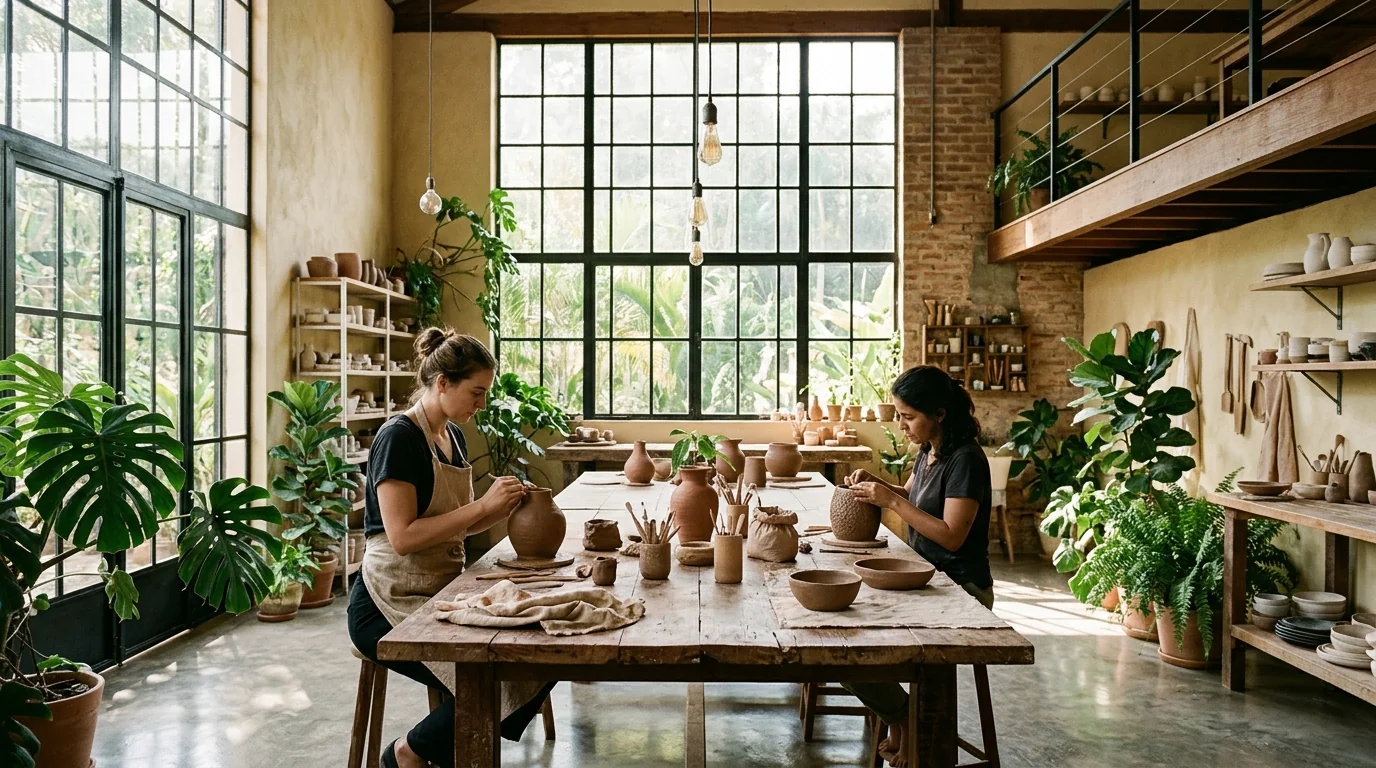
Across major Brazilian metropolises — especially São Paulo (neighborhoods like Pinheiros, Vila Madalena, and Santa Cecília), Curitiba (Batel and Historic Downtown), Rio de Janeiro (Botafogo and Santa Teresa), and Belo Horizonte (Savassi) —, pottery studios and carpentry workshops maintain multi-month waiting lists. The demographic composition is particularly telling: far from catering strictly to traditional retirees or full-time fine artists, the overwhelming majority of attendees are young professionals aged 22 to 40 from technology, finance, legal, and corporate strategy backgrounds, happily paying to trade keyboards and video calls for wet clay, wood chisels, and hand tools.
💡 Key Takeaways
- The Reinvention of the Third Place: The human need for casual, non-domestic socialization has shifted away from alcohol-centric nightlife toward collaborative, tactile maker spaces.
- An Antidote to Screen Fatigue: Hands-on artisanal work engages the somatosensory nervous system, calming the hyperstimulated dopamine loops driven by modern digital feeds.
- Urban Creative Economics: Independent ateliers operate at maximum capacity, successfully expanding monthly membership models with unlimited studio time (maker memberships).
- Low-Pressure Social Dynamics: Focusing jointly on physical crafting significantly lowers social anxiety, enabling natural, unforced, and meaningful conversations between strangers.
The Neuroscience of Touch: Why Clay and Woodwork Became Urban Therapy
The rapid spread of hands-on artisanal ateliers is far more than an aesthetic passing fad; it represents a physiological response to the cognitive overload of modern life. Recent studies in neuroaesthetics and cognitive psychology emphasize that the near-total loss of materiality in contemporary professional life — where entire weeks elapse manipulating pixels, spreadsheets, and ephemeral chats — induces a state of chronic somatosensory disconnection.
When an individual sits at a potter’s wheel or shapes a solid block of reclaimed timber with a hand plane, three restorative psychological mechanisms take effect:
  THE RESTORATIVE CYCLE OF MAKER THIRD PLACES
  ┌─────────────────────────────────────────────────────────────┐
  │ 1. Embodied Cognition & Involuntary Focus                   │
  │    ├─ You cannot touch a phone screen with clay-coated hands│
  │    └─ The mind enters an effortless psychological Flow State│
  ├─────────────────────────────────────────────────────────────┤
  │ 2. Immediate Physical Materiality                           │
  │    ├─ Real matter pushes back, warps, or cracks             │
  │    └─ Tangible pride of authorship over the finished object │
  ├─────────────────────────────────────────────────────────────┤
  │ 3. Side-by-Side Low-Pressure Socialization                  │
  │    ├─ Interaction occurs shoulder-to-shoulder at the bench  │
  │    └─ Eliminates the confrontational eye contact of bars    │
  ├─────────────────────────────────────────────────────────────┤
  │ 4. Grounded Dopaminergic Regulation                         │
  │    ├─ Slow, patient rewards (days for drying, firing, cure) │
  │    └─ Counteracts the addictive immediacy of algorithms    │
  └─────────────────────────────────────────────────────────────┘
The concept of side-by-side interaction is paramount: psychologists observe that human beings frequently feel vastly more comfortable sharing thoughts, expressing vulnerability, and forging genuine friendships when they are looking together at a shared physical task on a workbench, rather than staring directly at each other across an intimidating cocktail bar or forced corporate mixer. Clay and wood serve as natural, disarming conduits for human connection.
Business Models: From Weekend Workshops to Monthly Maker Memberships
The thriving ecosystem surrounding these new third places has matured into a resilient creative sector in Brazilian urban centers. Commercial models have evolved far beyond basic one-off weekend masterclasses:
- Continuous Studio Memberships (Open Studio): Students pay monthly fees ranging from R$ 350 to R$ 800 ($70 to $160 USD) for recurring access to electric kilns, pottery wheels, band saws, and shared workbenches, cultivating tight-knit, recurring communities.
- Hybrid Café-Studio-Gallery Spaces: Multifunctional venues integrating specialty light-roast coffee bars, indoor tropical gardens, and active glass-walled workshops, allowing casual neighborhood visitors to appreciate resident craftsmen while enjoying an espresso.
- Anti-Burnout Corporate Retreats: Leading multinational enterprises are actively replacing generic motivational hotel conferences with tactile studio immersions, bringing software engineering and management teams to artisan lofts to encourage analog collaboration and creative problem-solving.
According to research from the Brazilian Design Association (ABEDESIGN) and global consumer forecasts from WGSN, community-driven artisan ateliers are expanding at over 25% annually across southern and southeastern Brazilian capitals, revitalizing industrial heritage architecture and forgotten warehouse districts.
❓ Frequently Asked Questions (FAQ)
What defines the sociological concept of a “Third Place”?
Formulated by sociologist Ray Oldenburg, a third place is the physical environment where people spend leisure time separate from their domestic sphere (first place) and occupational environment (second place). Its core attributes include welcoming hospitality, accessibility, an absence of rigid social hierarchies, free-flowing spontaneous conversation, and regular attendees who sustain a welcoming sense of community.
Does someone need natural artistic talent or previous experience to participate?
Not at all. The foundational ethos of modern communal maker workshops is precisely to dismantle artistic elitism and perfectionism. Introductory courses focus on safe tool handling and basic material properties (pinching and coiling in pottery, sanding grits and natural oil finishes in woodworking), celebrating organic imperfections and treating trial-and-error as the core of the therapeutic process.
Why has this trend resonated so intensely with Gen Z and Millennials?
These cohorts matured in an omnipresent digital reality and frequently work in remote or hybrid arrangements, confronting unprecedented levels of urban loneliness and blurred work-life boundaries. Artisanal workshops provide precisely what virtual environments cannot offer: tactile grounding, deliberate slowness, face-to-face peer companionship, and the profound satisfaction of holding an object made with their own hands.
The Beauty of Craft and the Future of Urban Living
The expansion of these creative third places points to a healthier trajectory for Brazilian cities. By rediscovering the tactile joy of clay, raw timber, and communal making, urban centers are proving that a fulfilling human life cannot be contained within a smartphone screen.
While neighborhood bars will always retain a romantic spot in Brazilian bohemian heritage, they now share the city’s pulse with sawdust, damp earthenware, and the focused quiet of hands shaping raw material. In an increasingly automated world steered by invisible artificial intelligence algorithms, getting your hands dirty to create tangible beauty is the ultimate act of modern mindfulness.
🔗 References & Official Sources:
- Consumidor Moderno — Specialized research on evolving consumer lifestyles, experience economies, and urban well-being.
- WGSN Brasil — Trend forecasting on consumer behavior, modern Third Places, and the resurgence of tactile crafts in Latin America.
- Brazilian Design Association (ABEDESIGN) — Reports on creative economy expansion, independent design studios, and collaborative workshops in Brazil.
- Casa Vogue Brasil — Architectural and cultural coverage of multifunctional urban studios and contemporary artisanal design.
- Estadão Culture & Trends — Analysis of post-screen socialization habits among urban professionals in major metropolitan centers.