

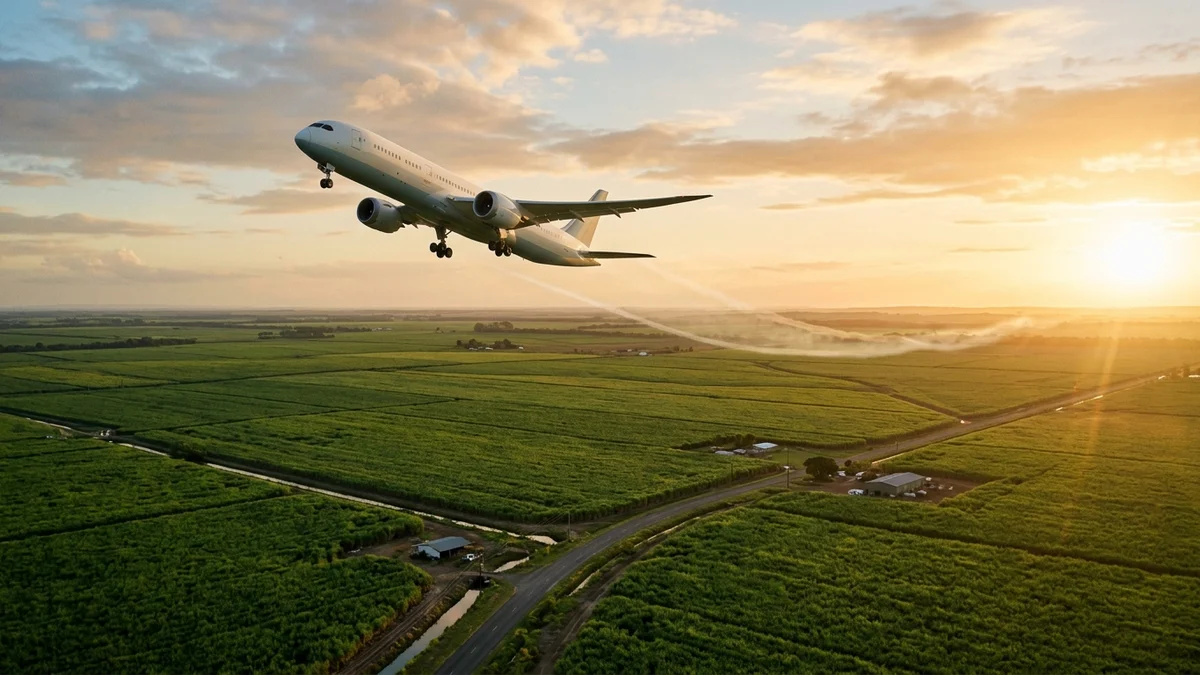
Commercial aviation accounts for nearly 3% of global carbon dioxide emissions and faces a non-negotiable regulatory ultimatum: achieving Net Zero emissions by 2050. Unlike ground mobility, which found its path in battery electrification, the laws of physics make heavy lithium packs non-viable for long-haul commercial airliners. For the next three decades, the only scalable technological answer is Sustainable Aviation Fuel (SAF).
At this planetary crossroads, Brazil is cementing its status as the world’s central clean fuel hub. Backed by the landmark Future Fuel Law (Federal Law 14,993) and over four decades of agricultural bioenergy leadership, international legacy airlines—from Lufthansa and British Airways to Delta and United—are securing long-term offtake agreements rooted in sugarcane ethanol.
Key Takeaways: At a Glance
- •Massive Carbon Reduction: Sugarcane ethanol-based SAF processed through the Alcohol-to-Jet (ATJ) pathway cuts lifecycle greenhouse gas emissions by up to 84% compared to standard fossil Jet-A1.
- •Capital Inflow: Brazil’s Future Fuel legislative framework is projected to catalyze over $45 billion (R$ 260 billion) in private biorefinery, logistics, and carbon-capture investments through 2035.
- •Binding Global Mandates: European airports under the ReFuelEU Aviation directive require progressively escalating SAF blend minimums (6% by 2030, rising to 70% by 2050), imposing severe financial penalties for non-compliance.
The Technological Breakthrough: Why Ethanol Surpassed Cooking Oil
In early SAF trials, the aviation sector leaned almost exclusively on the HEFA pathway (Hydroprocessed Esters and Fatty Acids), which refines used cooking oils (UCO) and animal tallow. However, HEFA quickly hit a biological ceiling: there is simply not enough waste frying oil on Earth to power the world’s fleet of 25,000 commercial passenger aircraft.
The game-changer came with the international certification of the Alcohol-to-Jet (ATJ) pathway by global standards authorities, including ASTM International and the International Civil Aviation Organization (ICAO) under CORSIA.
Under this certified process:
- Low-carbon ethanol (harvested mechanically with on-site biomass cogeneration and vinasse fertilization) is dehydrated into ethylene;
- Ethylene molecules undergo oligomerization and catalytic hydrogenation;
- The resulting synthetic hydrocarbon is molecularly indistinguishable from fossil kerosene (drop-in fuel), requiring zero modifications to existing aircraft jet engines or airport pipeline infrastructure.
Regulatory Clarity: The Impact of the Future Fuel Framework
Policy predictability was the missing catalyst needed to turn agricultural potential into high-tech industrial plants. Brazil’s new Future Fuel legislation establishes firm decadal targets:
- Beginning in 2027, airlines operating domestic flights in Brazil must demonstrate a minimum 1% annual emissions cut achieved via SAF;
- This mandate ramps steadily upward, reaching a 10% emissions reduction by 2037;
- Compliance is audited through a transparent digital tracking system overseen by the National Agency of Petroleum, Natural Gas and Biofuels (ANP).
According to estimates from the Brazilian Sugarcane and Bioenergy Industry Association (UNICA), this certainty has triggered unprecedented capital expenditure from international energy conglomerates building large-scale ATJ biorefineries across central and southeastern Brazil.
Global Skies Geopolitics: Brazil vs. The US and Europe
While the United States provides substantial subsidies for corn-based SAF under the Inflation Reduction Act (IRA), Brazilian sugarcane ethanol maintains an insurmountable ecological edge: an energy output-to-input ratio four times higher and significantly lower carbon intensity scores.
Meanwhile, the European Union, facing stringent constraints on arable land dedicated to energy crops, views South American production as an indispensable supply line. International carriers operating transcontinental routes are actively evaluating tankering strategies—maximizing refueling stops at Brazilian hubs to take advantage of favorable clean-fuel pricing.
Furthermore, complementary native agricultural feedstocks are expanding the supply envelope without displacing food production:
- Macaúba: A native high-yielding oil palm cultivated sustainably on degraded cattle pastures;
- Second-Crop Corn: Integrated into bioenergy plants with Carbon Capture and Storage (BECCS), delivering carbon-negative fuel streams.
The Horizon: Cost Curves and Scale
Despite widespread industry momentum, SAF still trades at a cost premium of two to three times that of fossil jet fuel. However, as global carbon compliance penalties escalate and new gigawatt-scale biorefineries achieve commercial manufacturing efficiencies, the green premium will narrow substantially before 2030.
For airlines striving toward Net Zero and for Brazil’s economic positioning, the SAF boom represents the ultimate validation of agricultural bioeconomy as a high-technology industrial powerhouse.
Frequently Asked Questions
Does SAF require engine or aircraft modifications?
No. SAF is certified as a drop-in synthetic fuel. Its chemical and thermodynamic properties match conventional fossil Jet-A1. Current international aviation standards permit SAF blends of up to 50% with fossil kerosene without needing any modifications to engines, fuel lines, or airport hydrant systems.
Why is sugarcane ethanol uniquely positioned for SAF production?
Sugarcane features one of the highest photosynthetic solar-conversion efficiencies of any commercial crop. Brazilian mills operate in an energy-positive closed loop: crushed bagasse powers local turbines, excess electricity feeds the public grid, and organic vinasse returns to fertilize the soil, yielding an exceptionally low lifecycle carbon footprint.
When will SAF adoption become mandatory in Brazil?
Under the Future Fuel Law (Lei do Combustível do Futuro), statutory SAF compliance begins in 2027, requiring commercial carriers on domestic routes to mitigate 1% of emissions using approved clean fuels, scaling annually to a 10% reduction by 2037.
🔗 Sourced Authorities & References:
- Brazilian Ministry of Mines and Energy (MME) — Future Fuel Regulatory Guidelines and National Biofuel Decarbonization Targets
- ICAO — International Civil Aviation Organization — CORSIA Global Environmental Aviation Standards and Approved SAF Feedstocks
- UNICA — Sugarcane and Bioenergy Industry Association — Technical Lifecycle Carbon Audits for Alcohol-to-Jet Pathways
- IATA — International Air Transport Association — Aviation Net Zero Roadmap, SAF Market Tracker, and Airline Fleet Mandates