
Over 80% of the world’s population — and nearly 99% of people living in North America and Western Europe — sleep beneath night skies washed out by pervasive artificial light pollution. In sprawling urban centers, an entire generation of children has grown up without ever gazing upon the silvery river of the Milky Way with their own eyes. In our hyper-connected reality, dominated by relentless notifications and the blue glow of digital screens, true, unadulterated darkness has become one of the rarest, most cherished luxuries on Earth.
This sensory deprivation has fueled one of the most dynamic sectors within experiential travel: astrotourism and expeditions to certified Dark Sky Parks. Discerning travelers, couples, and nature enthusiasts are no longer flocking to overcrowded monuments; instead, they are traveling across borders to witness the silent grandeur of the cosmos. In South America, sanctuaries such as Chapada dos Veadeiros, Desengano State Park, and Chapada Diamantina in Brazil are earning international acclaim as pristine havens for celestial contemplation and mindful wilderness travel.
Key Takeaways: What You Need to Know
- The Global Dark Sky Movement: Spearheaded by DarkSky International, dark sky certifications safeguard nocturnal ecosystems and enforce stringent architectural shielding standards to eliminate upward light spill.
- Latin American Trailblazer: Desengano State Park in Rio de Janeiro made history as the very first certified International Dark Sky Park in Latin America, establishing a benchmark for sustainable night ecology.
- The Stargazing Jewel of Central Brazil: Rising over 1,200 meters above sea level with bone-dry winter atmospheric clarity, Chapada dos Veadeiros tops national astrotourism potential metrics (IASTRO) for deep-sky observation.
What Is Light Pollution and Why Darkness Is Essential
Over the past century, excessive artificial night light has profoundly altered natural rhythms. Modern biology reveals that nocturnal light glare does far more than frustrate astronomers: it disorients migratory birds, disrupts nocturnal insect pollination, and blunts human melatonin production, directly deranging cellular circadian timing.
Preserving pristine darkness is not merely an ecological crusade; it represents a high-yield, sustainable economic model. According to DarkSky International, municipalities and regional reserves that transition to fully shielded, downward-facing warm fixtures (under 3,000 Kelvin) save upwards of 40% in municipal energy expenditures while attracting high-value, conscientious eco-travelers who stay longer, patronize local culinary artisans, and preserve wilderness serenity.
Chapada dos Veadeiros: Where Ancient Quartzite Meets the Cosmos
While Desengano secured official international certification, Chapada dos Veadeiros has become the magnetic heart of astrotourism in Brazil’s Central Highlands. The region’s geography delivers near-miraculous viewing conditions:
- Crystal-Clear Winter Atmosphere: Between May and September, the dry season in the Brazilian savanna (Cerrado) offers months of virtually cloudless skies and humidity levels rivaling high-altitude deserts.
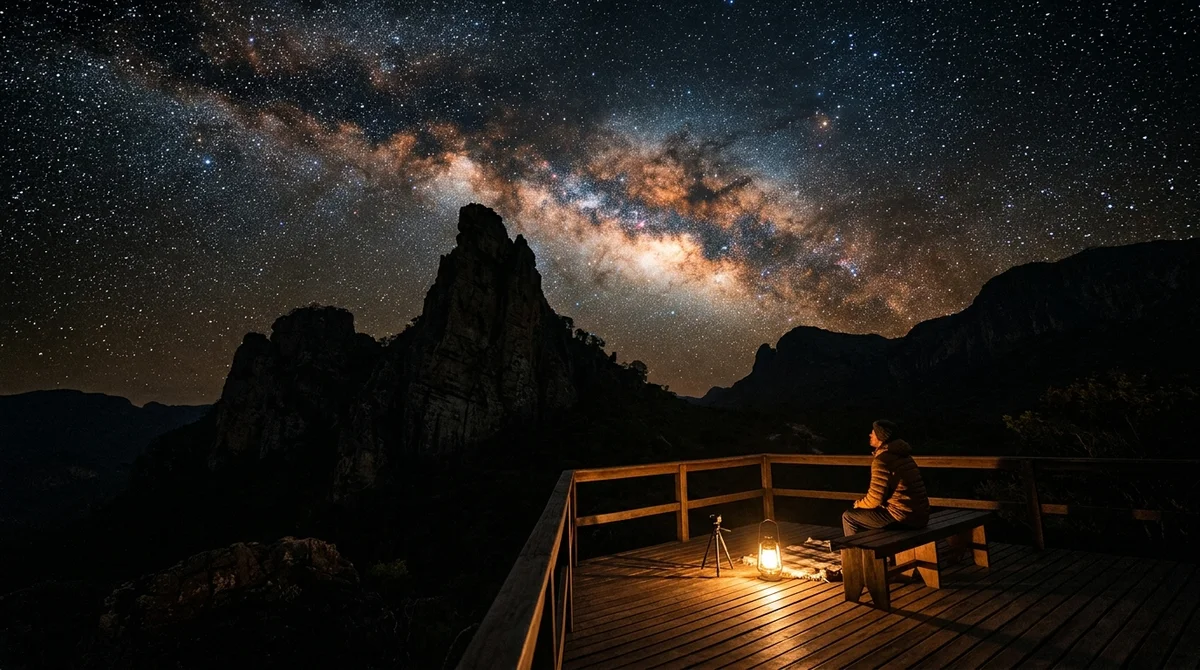
- Monumental Geological Formations: Billion-year-old quartzite plateaus, dramatic canyons, and twisted savanna flora provide an otherworldly foreground for long-exposure astrophotography and guided stargazing walks.
- Slow Luxury & Mindful Architecture: In sanctuary villages like São Jorge and Alto Paraíso, boutique eco-lodges and luxury glamping sites offer transparent geodesic domes, heated open-air plunge pools, and private viewing decks equipped with computerized Dobsonian telescopes and celestial maps.
In comprehensive IASTRO academic surveys, Chapada dos Veadeiros consistently captures maximum visibility scores, allowing travelers to discern Southern Hemisphere wonders — from the Magellanic Clouds to the radiant galactic center — with unassisted naked-eye brilliance.
The New Experiential Hospitality: Stargazing as Slow Luxury
The rise of astrotourism has catalyzed a profound evolution within boutique hospitality: shifting from passive accommodation to intentional, regenerative travel. Hoteliers and private reserves have recognized that their most valuable amenity awakens after twilight.
Operators now curate intimate multi-course “stargazing dinners” paired with regional wines, accompanied by resident astrophysicists and indigenous cultural historians who recount ancestral cosmology, such as Tupi-Guarani constellations (the Old Man, the Ema).
This elevated storytelling transforms a weekend getaway into a transcendent journey of existential perspective, gently reminding guests of the humbling scale of human worries when set against the infinite fabric of space.
Practical Guide: How to Plan an Astrotourism Expedition
To optimize your stargazing journey with comfort and photographic success, veteran astronomers emphasize three cardinal rules:
- Follow the Lunar Cycle: Schedule your travels strictly around the New Moon or late waning crescent. A bright Full Moon illuminates the upper atmosphere, washing out the delicate spiral dust lanes of the Milky Way.
- Layered Thermal Clothing: Night temperatures at high elevations across the Brazilian plateau drop precipitously, frequently dipping below 10°C (50°F) before dawn. High-performance windbreakers and comfortable hiking footwear are essential.
- Red Light Only: Never illuminate celestial observation decks with standard white flashlights or smartphones. The human eye requires 20 to 30 minutes to complete rhodopsin-driven dark adaptation (scotopic vision); a single second of bright white light instantly resets this biological clock. Use red-filtered headlights exclusively.
Frequently Asked Questions
What exactly defines astrotourism?
Astrotourism is a specialized branch of sustainable ecotourism centered around visiting locations free from artificial light pollution to observe, photograph, and learn about the night sky, planets, stars, meteor showers, and celestial events.
What is required for a destination to become a certified Dark Sky Park?
To obtain Dark Sky Park certification through DarkSky International, a reserve must demonstrate exceptional atmospheric clarity and natural darkness, enforce strict, fully shielded municipal lighting codes, and offer ongoing public astronomy and conservation education.
What are the best months for astrotourism in Central Brazil?
The winter dry season, stretching from May through September, is universally acknowledged as the prime season for stargazing across Central Brazil (Goiás, Minas Gerais, and Bahia), thanks to zero rainfall, low humidity, and optimal positioning of the Milky Way core.
Conclusion: Finding Healing in the Dark
In a world overwhelmed by nonstop digital noise and concrete horizons, casting our eyes upward toward an untouched cosmic canopy is an act of deep biological restoration. Astrotourism reminds us that to regain clarity about our path on Earth, all we sometimes need is the courage to turn down the lights.
Have you ever experienced the awe of standing under a truly dark, star-filled sky? Share your favorite night sky memories with our editorial team!
🔗 Consulted Sources & Scientific References:
- DarkSky International — International Dark Sky Places conservation guidelines and light pollution metrics
- Condé Nast Traveler — The rise of nocturnal tourism, dark sky preserves, and slow luxury travel
- Embratur / Ministério do Turismo — Mapping sustainable travel routes and experiential ecotourism in Brazil
- Instituto Estadual do Ambiente (INEA-RJ) — Certification of Desengano State Park as Latin America’s first Dark Sky Park