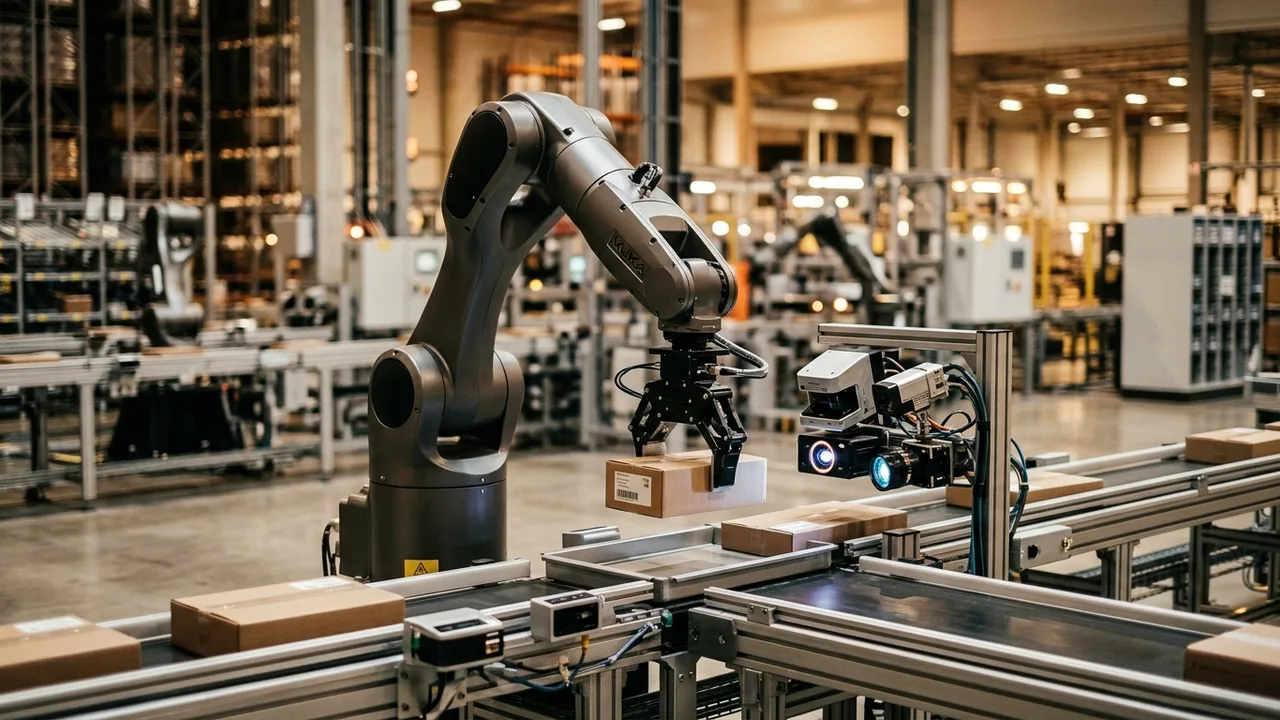
For the past two years, viral videos of bipedal robots performing backflips or handling espresso cups dominated social media feeds, creating the widespread illusion that human-shaped machines would take over factory floors before the decade’s close. However, the corporate reality of 2026 presents a radically different landscape: the authentic revolution of Embodied AI does not require legs or a human face, but articulated robotic arms, high-precision tactile grippers, and spatial vision sensors embedded directly into automated assembly lines and fulfillment hubs.
Recent strategic reports from institutions like Gartner Research and deep investigations by MIT Technology Review highlight a profound gap between venture-backed expectations and economic reality. According to Gartner, fewer than 20 global enterprises will operate humanoid robots at continuous commercial scale before 2028. In sharp contrast, the deployment of polyfunctional robots powered by VLA (Vision-Language-Action) foundation models surged by over 140% across the past twelve months, reshaping global supply chains and precision manufacturing.
📌 Key Takeaways: What You Need to Know
- The Humanoid Hype Chasm: Engineering two-legged balance requires excessive mechanical complexity and heavy battery payloads, making operational costs prohibitive for 95% of industrial tasks.
- The Rise of VLA Models: Unlike classic robots programmed with brittle coordinate code, Vision-Language-Action architectures interpret natural language instructions and map environmental visual cues directly into motor kinematics.
- Practical Industrial Rollouts: Modern fulfillment networks, automotive hubs, and automated agro-processing plants are actively leveraging modular robotic cells for zero-defect quality inspection and dynamic sorting.
Moravec’s Paradox and the Physical Data Bottleneck
For decades, robotics remained constrained by Moravec’s Paradox: cognitively taxing problems for humans (such as playing master-level chess or drafting legal briefs) proved relatively straightforward for machine learning, whereas simple physical tasks that a toddler manages with ease (like holding a ripe strawberry without crushing it or stepping over an obstacle) demanded extraordinary computing power.
Large Language Models (LLMs) granted artificial intelligence the power to reason in the abstract domain. Yet intelligence still lacked a physical body capable of navigating real-world mechanics. As noted by the MIT Computer Science and Artificial Intelligence Laboratory (CSAIL), the primary bottleneck was never the absence of neural architectures, but the extreme scarcity of real-world physical motion data.
While language models trained on trillions of public web tokens, no corresponding “internet of physical touch and motor mechanics” existed. To overcome this hurdle, robotics pioneers began developing photorealistic physics simulators and haptic data-capture suits to record human dexterity, feeding multimodal networks that unify computer vision with real-time motor actuation.
VLA Models: Shifting from Rigid Code to Adaptive Intelligence
Traditional industrial robotics has always been unforgivingly rigid: if a component shifted five millimeters out of place along a conveyor belt, the mechanical arm halted or discarded the part.
Vision-Language-Action models overturn this vulnerability:
- Continuous Multimodal Perception: High-framerate 3D stereoscopic cameras and ultrasonic sensors monitor ambient lighting, weight shifts, surface textures, and spatial drift in sub-millisecond intervals.
- Zero-Shot Task Generalization: Robots no longer demand custom reprogrammed scripts for every packaging variation. Upon receiving a natural voice command like “inspect for tears, set aside damaged packages, and palletize fragile parcels”, the VLA engine breaks the directive into sequential physical micro-actions.
- Imitation Learning via Demonstration: Instead of writing weeks of trajectory logic, warehouse technicians physically guide the robotic arm through the target movement for five minutes, allowing the network to internalize and refine the motion autonomously.
This newfound flexibility eliminates the immense capital expenditure previously required for rigid factory retooling, enabling agile enterprises to modernize their workflows without shutting down shifts.
Practical Deployment: Real-World Industry and Supply Chains
Across competitive manufacturing hubs and emerging logistics corridors, return on capital strictly dictates technology choices. Rather than novelty demonstrations, industrial leaders focus capital allocation across three high-impact domains:
- Logistics and Smart Fulfillment: Automated sorting hubs deploy autonomous mobile robots (AMRs) guided by VLA models to streamline order picking, driving shipping error rates down by up to 40%.
- Automotive Assembly and Precision Tooling: Manufacturing plants integrate collaborative robots (cobots) operating side by side with technicians, taking over hazardous or repetitive duties such as blind-angle laser welding and micro-fastening.
- Agri-Tech and Food Processing: High-speed sorting lines inspect grains, specialty fruits, and coffee crops, isolating defects and grading freshness at millisecond speeds.
Frequently Asked Questions (FAQ)
Will humanoid robots be abandoned by industry?
No. They will continue to evolve for high-hazard niche assignments—such as deep-space exploration, bomb disposal, and nuclear decommissioning—or inside facilities architected exclusively around the human body. For high-throughput mass production, wheeled, tracked, and gantry-mounted modular arms offer superior mechanical stability, lower energy drain, and exponentially faster ROI.
What does the VLA acronym stand for in robotics?
VLA stands for Vision-Language-Action. It refers to an AI architecture that unifies visual perception and natural language comprehension with the direct synthesis of mechanical torque, trajectory, and actuation controls.
Does Embodied AI displace workers across industrial floors?
Early deployment data indicates a reconfiguration of work rather than pure displacement: repetitive, ergonomically damaging tasks become automated, while assembly-line operators transition into supervisors and training specialists for intelligent robotic cells.
Trend Summary: Intelligence Crossing into Physical Matter
The defining milestone of artificial intelligence in 2026 is its emancipation from digital screens. By acquiring sensory awareness, calibrated force feedback, and physical presence, AI evolves from an advisory assistant into an adaptive, collaborative industrial force.
For leaders in engineering, supply chains, and technology, the takeaway is unambiguous: while marketing headlines chase the aesthetic of human-like form, enduring business value is created through agile, purpose-built embodied intelligence.
🔗 Consulted Authorities & Reference Sources:
- Gartner Research — Hype Cycle for Robotics and Autonomous Physical Systems
- MIT Technology Review — The Rise of Embodied AI and the Physics Data Frontier
- MIT CSAIL — Hierarchical Planning and Vision-Language-Action Models in Real-World Robotics
- IEEE Spectrum Robotics — State of Industrial Manipulation and Multimodal Machine Learning