

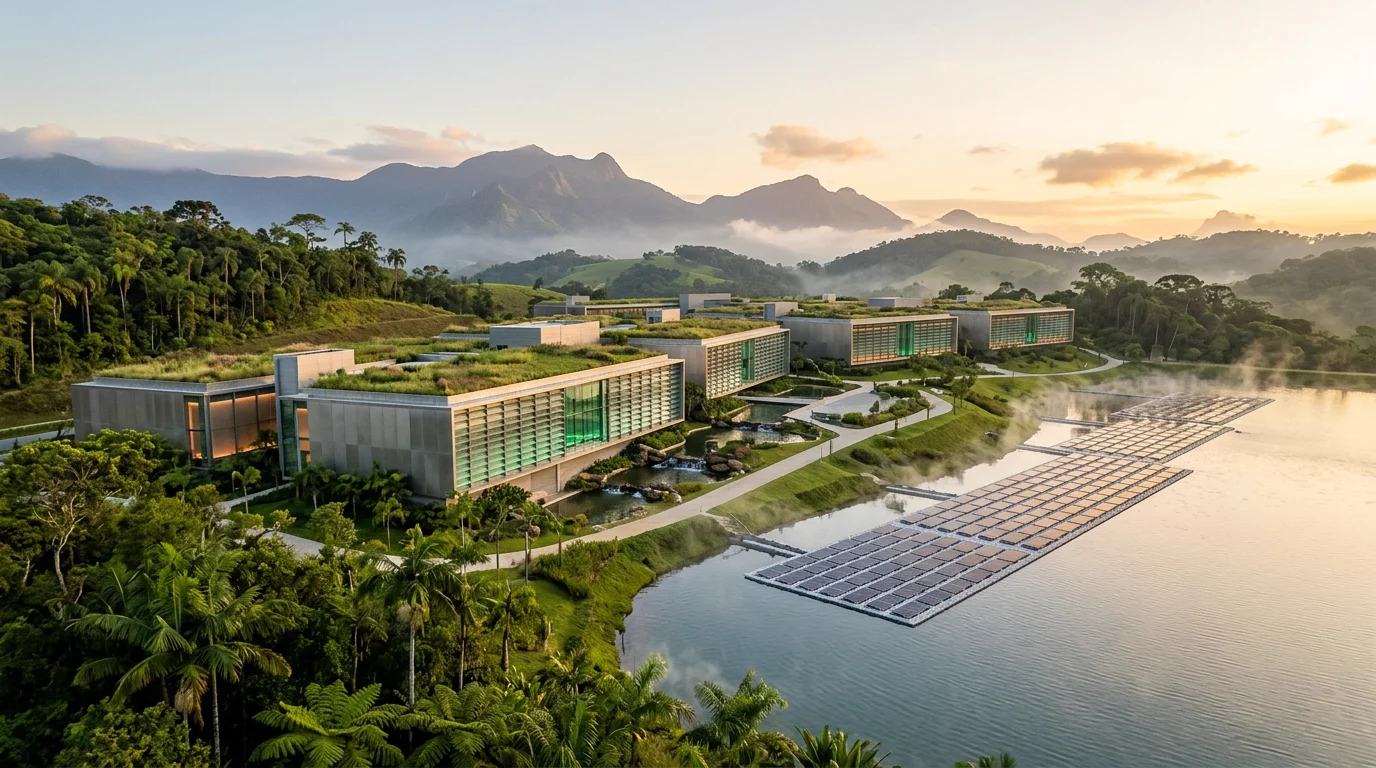
The fierce global race for generative artificial intelligence has slammed into an unyielding physical wall: electrical power. While the initial wave of Large Language Models (LLMs) was constrained by the scarcity of specialized graphics processing units (GPUs), by 2026 the absolute limiting factor is the physical capacity and carbon intensity of the power grid. Traditional data center epicenters across the United States (such as Northern Virginia) and Western Europe (including Dublin and Frankfurt) face grid moratoriums, connection queues spanning up to seven years, and persistent reliance on fossil-fuel peaker plants.
Against this backdrop of global compute starvation, Brazil has rapidly emerged as the undisputed mecca for sustainable, high-performance computing. With more than 88% of its national electrical grid powered by clean, renewable resources — an exceptional blend of vast hydroelectric reservoirs with dispatchable capacity, world-class onshore wind farms in the Northeast, and massive solar utility parks —, the nation has converted its ecological endowment into an indispensable geopolitical technology asset.
Tech heavyweights such as Microsoft, Google, AWS, Oracle, CloudHQ, and Scala Data Centers have committed capital expenditures running into tens of billions of dollars to build hyperscale campuses engineered specifically for massive AI training and real-time inference workloads.
💡 Key Takeaways
- The Global Energy Bottleneck: Running deep learning clusters demands continuous gigawatts. Saturated power grids across developed economies threaten corporate Net-Zero commitments.
- Brazil’s Clean Power Advantage: Boasting an 88.2% renewable energy grid, Brazil provides firm, cost-effective, and carbon-free baseload power, paired with high-capacity transatlantic submarine fiber cables.
- Closed-Loop Liquid Cooling Innovations: Modern campuses are bypassing traditional air conditioning in favor of direct-to-chip liquid cooling (DLC), shrinking water evaporation to zero and maintaining Power Usage Effectiveness (PUE) below 1.15.
- From Commodity Exporter to Digital Sovereign: Brazil is transitioning from exporting iron ore and agricultural goods to exporting compute power, anchoring sovereign AI infrastructure across Latin America.
Grid Exhaustion and the Geopolitics of Gigawatts
Power consumption for AI-specialized infrastructure dwarfs that of enterprise cloud hosting. A single high-density rack equipped with next-generation neural accelerators can draw up to 120 kW — equivalent to the power requirement of an entire residential apartment complex. At campus scale, clusters demanding 500 MW to 1 GW are no longer speculative concepts, but baseline design specifications.
In conventional hubs across North America and Europe, utilities cannot deliver such massive loads without re-firing retired coal plants or overwhelming aging transmission networks. Tech giants that pledged aggressive decarbonization goals saw their Scope 2 emissions surge unexpectedly.
This is precisely where Brazil’s National Interconnected System (SIN) disrupts the global landscape:
- Unrivaled Seasonal Complementarity: The synchronized integration between hydro basins in the Southeast/South and booming solar and wind generation in the Northeast delivers a continuous, 24/7 carbon-free power curve.
- Competitive Levelized Cost of Electricity (LCOE): Brazil’s deregulated free energy market enables long-term Power Purchase Agreements (PPAs) at megawatt-hour tariffs substantially lower than those found in congested US and European zones.
- Low-Latency Subsea Superhighways: Multiple modern transoceanic submarine fiber cable routes linking Fortaleza, Rio de Janeiro, and São Paulo directly to financial hubs in New York, Lisbon, and Miami ensure compute processing latency remains well within global operating tolerances.
Water Stewardship and High-Density Cooling Architectures
Rapid infrastructure expansion inevitably faces stringent environmental scrutiny. Historically, massive water evaporation in cooling towers has sparked public pushback in drought-sensitive regions. In response, modern Brazilian facilities built across São Paulo State (such as Barueri and Campinas), the Ceará industrial hub (Pecém), and the South are adopting advanced engineering protocols.
The standard architecture deployed in these new clusters is direct-to-chip liquid cooling (DLC) coupled with closed-loop fluid recycling. This closed architectural loop eliminates ongoing municipal water depletion and drives Power Usage Effectiveness (PUE) down to near-theoretical floors of 1.10.
Furthermore, hyperscale operators are structuring self-generation joint ventures backed by dedicated wind and solar farms. By injecting brand-new clean generation directly into the national grid to match their exact draw, data centers ensure their operation puts zero upward pricing pressure on residential energy consumers.
❓ Frequently Asked Questions (FAQ)
Does Brazil’s tropical climate make cooling servers excessively expensive?
No. Advanced direct-to-chip liquid cooling and immersion architectures allow processors to operate reliably at significantly higher return-water temperatures, eliminating the need to chill indoor server rooms down to 18°C. Moreover, Brazil’s abundant and cheap renewable electricity easily offsets any slight ambient thermal differences compared to sub-arctic locations.
Can the Brazilian power grid handle this influx without causing blackouts?
Yes. The hyperscale build-out operates primarily through the deregulated Free Power Market (ACL) and dedicated self-generation concessions. Operators fund new private substations, transmission lines, and dedicated renewable energy farms, adding net-new generation capacity to the national grid rather than competing with residential municipal supply.
What is the broader economic impact beyond construction and real estate?
Hosting foundational AI physical infrastructure stimulates deep tech engineering ecosystems, attracts localized specialized hardware research, and retains elite data science talent domestically. It also enables Brazilian enterprises and public institutions to train sovereign AI foundation models adapted to regional language, culture, and regulatory frameworks with near-zero latency.
Strategic Trajectory: From Raw Materials to Global AI Infrastructure
Brazil’s rise as a premier green AI computing hub marks a transformative shift in the global knowledge economy. Rather than functioning purely as an end-consumer of algorithms hosted overseas, the country is cementing its role as the vital, bio-powered engine supporting the planet’s digital cognitive layer.
By marrying natural resource advantages, a unified interconnected grid, and rigorous environmental engineering, Brazil demonstrates that the future of artificial intelligence does not need to compromise planetary sustainability.
🔗 References & Authoritative Sources:
- Ministry of Mines and Energy (MME) - Brazil — Consolidated statistical data on national energy balance and self-generation regulations.
- Energy Research Office (EPE) — Strategic projections on high-density computational load expansion and clean grid integration.
- International Energy Agency (IEA) — Global Report on Electricity Demand, Data Centers, and Artificial Intelligence.
- ABRADETI (Brazilian Data Center Association) — Hyperscale investment tracking and PUE efficiency benchmarks across Latin America.
- BloombergNEF — Market reports on renewable competitiveness and the global technological transition.